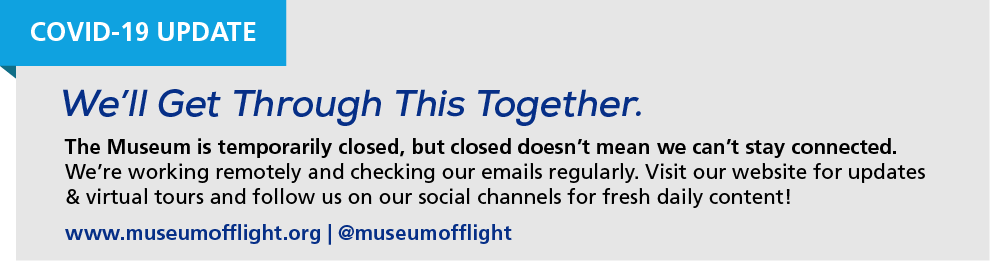
While Summer 2020 may not be operating as usual for our Museum education programs, there will still be many exciting opportunities for our youth to engage in fun and impactful learning experiences through our Boeing Academy for STEM Learning. We are sharing some of those opportunities with you in this message.
One of our newly-developed virtual offerings will be a 75-hour course called Aeronautical Explorations*, which will be taught by Museum educators and pilots Michael Graham and Captain Coleman Boettger. This is an exploratory course that will allow participants (rising 9th through 12th graders) to interact with aerospace/aviation professionals, enhance their resume, develop a network of people who can help them get where they want to go, and be even better prepared for their future upon course completion. Course content includes topics such as aviation history and careers, weather and meteorology, navigation, aerodynamics and more that you will see included on the promotional flyer and on our webpage. As part of the $499 course fee (financial aid available), each student will receive flight simulation software, a joystick, and a drone—theirs to keep at the end of the course. We just went live with this course on Tuesday, and within an hour a student from Illinois was the first to register! Several more from Texas have also registered, so we are hoping to have student participation from across the country. Class capacity is 52 students, and there are lots of seats still available. Your help in promoting this new course will be so very appreciated! Aeronautical Explorations replaces Private Pilot Ground School, which we have offered each summer for the past five years in partnership with Puget Sound Skills Center and Green River College
We are also getting ready to launch a new program series: Boeing Academy for STEM Learning @ Home Virtual that offers a virtual camp-like experience for three groups of learners: those in grades 3-5, 6-8, and 9-12. An overview of this program can be seen at https://youtu.be/aRvLnmgQCC0, featuring Museum educator Natalie Copeland. We offered the first preview week, June 1 to 8, for free to our Connections students and children of Museum staff; and all the sessions filled within a few hours of opening registration.! We hope the same will be true as we promote additional STEM programs over the summer months. Our webmaster is in the process of creating a webpage for these offerings, and you should be able to find information HERE within the next week. Again, please share with your family and friends!
Most of you are likely familiar with our Western Aerospace Scholars (previously Washington Aerospace Scholars) program, the Museum's premier space science program for high school students that was developed in partnership with NASA and the University of Washington. It, too, will be operating virtually this summer for both sophomores and juniors in Washington and Oregon. Montana is planning to operate in-person at the Montana Learning Center in Helena.
Since the Museum closed to the public in March, we have also offered our Flying Gizmo show to children around the world, with sponsorship from a global corporation; and, our Planetarium is also being offered to virtual audiences. There's more to come, too!
We will keep you updated as we navigate our way to whatever a new normal may look like. Please know how much we appreciate your support of our Museum education programs and sharing the news of our exciting new offerings. If you have any questions, please contact me, Seth or Melissa.
Wishing you and your family the very best as this pandemic continues to impact the way we live, work and play—
My best,
Reba
*Aeronautical Explorations replaces Private Pilot Ground School, which we have offered each summer for the past five years in partnership with Puget Sound Skills Center (PSSC) and Green River College; unfortunately, we are unable to offer this popular program in Summer 2020 due to COVID and restrictions that prevent PSSC from operating.
| | Reba Gilman | Vice President of Education |
| |