Free Science Curriculum Workshop at AAAS Annual Meeting in Austin, Texas


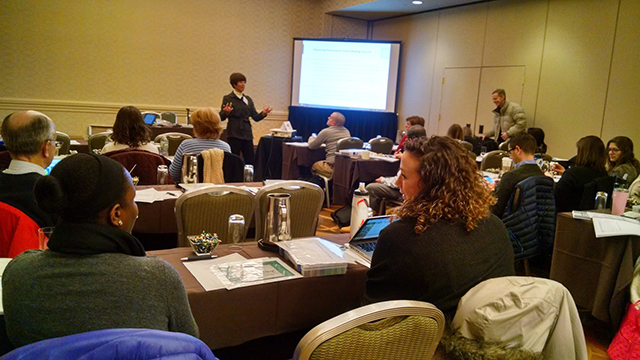
You are invited to submit an application to attend a free workshop presented by Project 2061, the science education initiative of the American Association for the Advancement of Science. The workshop is designed especially for those who teach middle school science or high school biology, or serve as a science specialist or an administrator with science curriculum responsibilities. The workshop, "Supporting Three-dimensional Learning and Teaching With New Curriculum Materials," will be held on Thursday, Feb. 15, 2018, at the Hilton Hotel in Austin, Texas, in conjunction with the 2018 Annual Meeting of AAAS.
Apply Today »
Led by the Project 2061 development team, the workshop will introduce participants to a pair of curriculum units designed to give students a coherent understanding of matter and energy in living organisms.
Toward High School Biology is designed for use in middle school and focuses on helping students understand what happens to atoms and molecules during the chemical reactions that result in the growth and repair of living organisms.
Matter and Energy for Growth and Activity is for high school biology students and expands on the middle school unit to help students understand the relationship between matter and energy changes. The unit also explores how energy-releasing and energy-requiring chemical reactions are coupled in living systems so that organisms can carry out basic life functions.
The workshop will demonstrate how the units tackle some key problems, including persistent misconceptions that many students have about matter and energy. Participants will also learn how the units align with Next Generation Science Standards and will have an opportunity to try out some sample activities and explore online teacher resources that are available with the units.
Certificates of participation in this AAAS-sponsored professional development workshop will be provided to all teachers who attend. A light breakfast and lunch will be served. Teams of two or more educators representing middle and high schools are encouraged to apply. You will be notified by email if you are selected to attend.
 
Renewal Alert
AAAS Manage Your E-mail Subscription Preferences | Unsubscribe | Privacy Policy

AAAS/Science | 1200 New York Avenue NW | Washington, DC 20005 | USA
+1 202-326-6417 | 1-866-434-2227 (toll-free in the USA)

Copyright © 2017 American Association for the Advancement of Science.

Popular posts from this blog

OSPI Bulletin 065-23: Learning Standards Review Update

Summary:  This bulletin provides an update to the information about the learning standards review project addressed by Superintendent Reykdal’s letter to district superintendents dated February 14, 2023. It includes current information about the reviews of the Washington state learning standards for English/Language Arts, mathematics, and science. It also includes a timeline for the review process. Key Audiences:  Educational Service District Superintendents, School District Superintendents, School District Business Managers, School District Curriculum Directors OSPI's Bulletin re: Math, ELA, Science: [ PDF ] Science Updates: [ PDF ]

From Museum of Flight: Washington Aerospace Scholars (WAS) Recruitment now underway!

FROM THIS PAGE: [ LINK ] Washington Aerospace Scholars (WAS) is an online distance learning course and summer experience specifically designed for high school sophomores and juniors interested in science, technology, engineering and math (STEM) fields. The online curriculum is a University of Washington college course focused on NASA’s space exploration program as well as topics in earth and space science. If they successfully complete the online curriculum, students are invited to participate in multi-day summer experiences that provide them to the opportunity to work with STEM professionals, NASA scientists, university students and STEM educators. Why should a student participate in WAS? Participating in the online distance learning course helps students understand the components and expectations for college level coursework while they are still in high school, particularly the importance of good time management and the ability to prioritize. Being able to state on a resu...

[STATE-LEVEL] ASSESSMENT SHOULD NOT DRIVE INSTRUCTION

Regional Science Coordinators are developing an online orientation class for the new Washington Comprehensive Assessment of Science (WCAS). We have involved OSPI’s Science Assessment lead, Dawn Cope and OSPI’s Director of K-12 Science, Ellen Ebert, in the process as well as Lois Sherwood from WSTA. In our first planning meeting, I wanted to hear the most important message from each person at the [virtual] table. Dawn Cope of the assessment department was the first to speak up and quite pointedly said, “assessment does not drive instruction.” That pretty much spoke for the rest of us. What does that mean for teachers in Washington State where we’ve spend the last 13 years writing “powerful classroom assessments” that mirrored the content and format of the WASL and the MSP? Assessment systems serve specific purposes . They are developed to provide specific kinds of data for those purposes. And an assessment developed at the state level to inform state-wide decisions does not l...